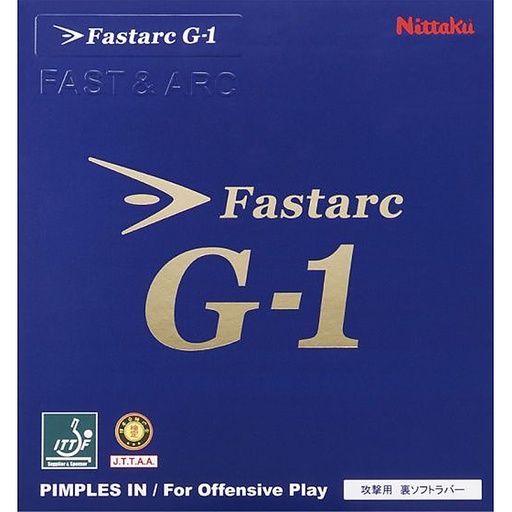
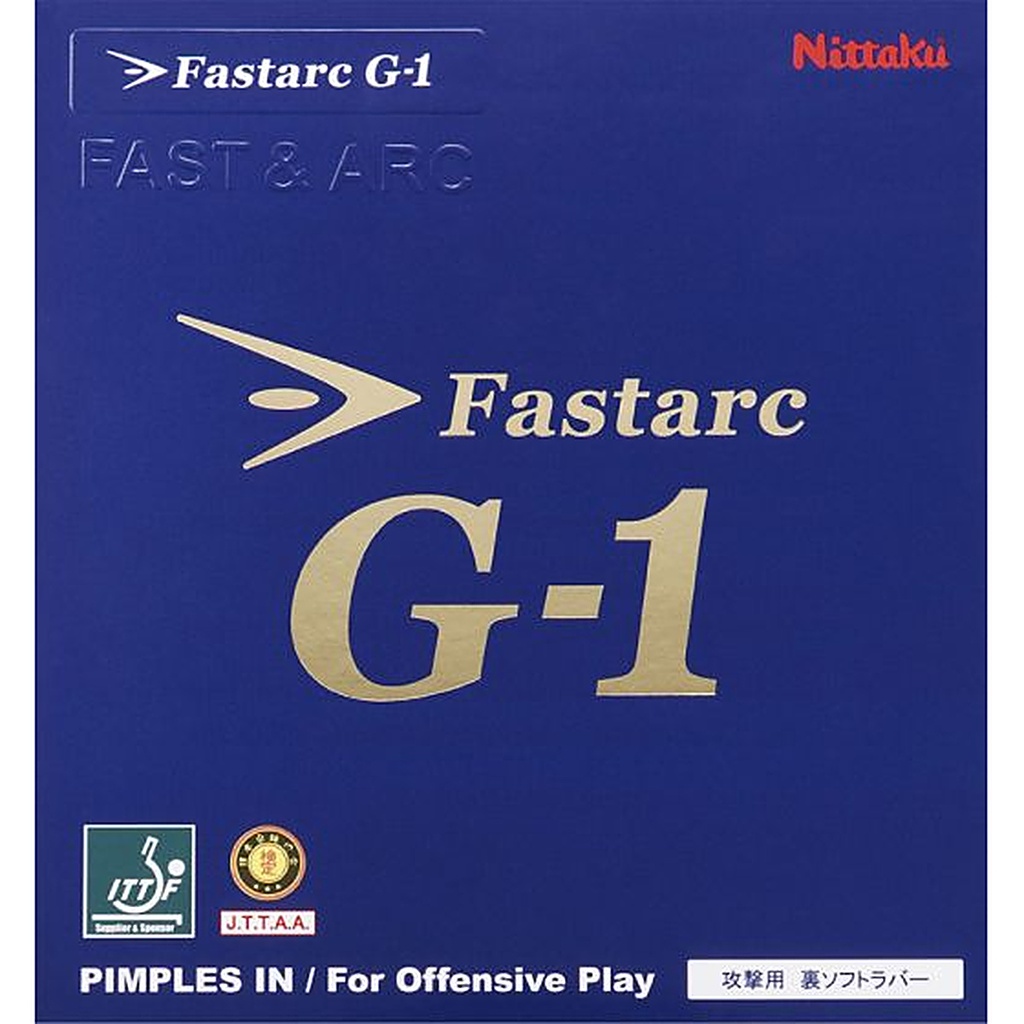
Fastarc G-1 is Nittaku's spin-drive rubber, the one the company still lists as the sheet that grips the ball and throws an arc. It has been on sale since 2010. The current official page gives it code NR-8702, calls it an inverted rubber made in Germany, and prints a speed of 15.00 and a spin of 12.50 on Nittaku's own scale. There is no figure in the "variation" column.
The sponge, and which scale the number is on
Nittaku's sponge hardness for G-1 is 37.5. In brackets it adds the German-scale figure, 47.5. Those are the same sponge written two ways. Nittaku's 37.5 and a Butterfly 44 sit on different scales, so the useful comparison is the one Nittaku prints beside it, against C-1 and S-1.
Nittaku splits the Fastarc family in one sentence each. G-1 is the one that grips and holds its own in a driving rally. C-1 is the balanced rally rubber, for a steady game over the table and for two-winged counter-driving. S-1 is the speed-smash rubber, for hitting and blocking from close and mid distance. If you want the arc and the grip, G-1 is the one they point you at. If you want a flatter, quicker ball, they point you at S-1.
The sponge is what Nittaku calls a strong sponge: a hard feel that still holds the ball and throws it. The topsheet is their tension spin sheet, a packed pip layout they say passes power into the ball and does not get pushed around in a counter-hitting rally.
Thickness
The official thicknesses are middle, thick, extra thick and max. Nittaku's thickness guide puts middle at 1.4 to 1.7 mm, thick at 1.7 to 1.9 mm, extra thick at 1.9 to 2.1 mm, and max at 2.1 mm upwards. Max was added on 1 July 2021; before that the range stopped at extra thick.
On the Spinfinity page the choices in stock are 1.8, 2.0 and max, in red or black. That is their thick, extra thick and max. The 1.8 is the controlled one of the three. The 2.0 is the match thickness for most club players who already loop. Max is there if the 2.0 feels too tame and you can live with the weight. Nittaku's own guidance is that a thicker sponge is faster and harder to place, and that it makes the bat heavier.
Who Nittaku says uses it
Nittaku's product page names Mima Ito and Masataka Morizono among the players it lists on G-1. Morizono's comment there is about the backhand: a strong grip that suits his chiquita, and a sheet he says he has kept on that wing since his school years. Ito's published comment, dated in the magazine to December 2018, is about the ball kicking on for the opponent and about her counters dipping into the net. Both are the manufacturer's own quotes.
The list is not a match-day check. Honoka Iwakoshi is also named on that page, and Table Tennis Kingdom's May 2026 issue, describing her setup as of March 2026, quotes her saying she had used G-1 on both sides from high school and had later moved the forehand to Hammond Z2 because she wanted more power. Buy G-1 for the sheet Nittaku describes, not because a name on the page guarantees it is on their bat this week.
Price
The Fastarc G-1 is in stock at £35.33 on promo (was £37.99). Red and black are both listed, in 1.8, 2.0 and max. It suits a player who loops and counters and wants the ball to hold on the sheet. It is a poor first rubber if you are still learning to push, because the sponge is hard and a thin contact skids.
Sources: Nittaku Fastarc G-1 official product page (2026-11-23) · Nittaku rubber basics: sponge thickness bands (2024-02-16) · Spinfinity product page, price and thicknesses (2026-11-23) · Table Tennis Kingdom: Honoka Iwakoshi on her rubbers, May 2026 issue (2026-05-01)