What is the difference between long pimples, short pimples and anti-spin?
Short pimples face outwards and are short, wide and close together; they are fast and flat, and less affected by incoming spin. Long pimples are longer, thinner and further apart; they bend on contact and often reverse the opponent's spin. Anti-spin is a smooth inverted rubber with very little friction, so it neither creates much spin nor grips the incoming spin, returning a slow, flat ball.
A quick reminder: inverted rubber
Most players use inverted (pimples-in) rubber, with the smooth side out over a sponge. Table Tennis England calls this by far the most used type and recommends it for beginners, because it lets you learn every basic stroke. The rubbers in this guide are specialist options.
Short pimples
Short pimples face outwards and are short, wide and close together. Table Tennis England notes that they are often used on the backhand to vary spin and speed against a normal rubber, to help with blocking and counter-attacking, and to support players with a weaker backhand. Because less of the ball touches the rubber, short pips react less to incoming spin, which makes them good for fast, flat hitting and blocking close to the table. They create less spin of their own than inverted rubber.
Examples we stock: Spinlord Waran, Tibhar Speedy Soft D.TecS, Nittaku Moristo SP and Victas Spinpips D1.
Long pimples
Long pimples face outwards and are longer, thinner and further apart than short pimples. Table Tennis England warns that they often reverse the spin, which makes them difficult to play with and against, and does not recommend them for beginners. A heavy topspin loop blocked with long pips tends to come back with backspin, and a push can return as light topspin or float.
Long pips are used two ways:
- Without sponge (OX) for close-to-the-table blocking and disruption. Our product notes for Tibhar Grass D.TecS describe it as famous in OX for reversing spin on blocks.
- With a thin sponge for chopping from long distance, as classic defenders do.
Other examples we stock: Victas Curl P1V and Donic Spike P1.
Anti-spin
Anti-spin looks like inverted rubber, but its surface is deliberately slippery. Table Tennis England describes it as a reverse rubber with little friction that does not impart spin and negates it. The equipment guide at Open TT explains that it works differently from long pips: it does not reverse spin by bending, it simply grips so little that the ball comes back flat and slow, with much less spin than the opponent expects. It is usually soft and slow, and is mostly used on the backhand by blockers who combine it with an attacking rubber on the forehand.
Examples we stock: Yasaka Anti Power, Nittaku Best Anti and Tibhar Ellen Def.
What do the rules say?
Under ITTF Law 2.4.3, a side of the blade must be covered either with ordinary pimpled rubber (pimples outwards, total thickness including adhesive less than 2.05 mm) or with sandwich rubber (sponge plus pimpled rubber, pimples in or out, total thickness including adhesive less than 4.05 mm). Pimples must be evenly spread at a density of 10 to 30 per cm², and the pimpled layer of a sandwich rubber must be no more than 2.0 mm thick. As with any rubber, one side must be black and the other a bright colour (2.4.6), and competition rubbers must be ITTF-authorised. Our equipment rules guide covers the rest.
Who should use them?
- Short pips: players who like to hit and block flat close to the table, often on the backhand.
- Long pips: blockers who want to disrupt, and choppers who defend from distance. Learn the basic strokes on inverted rubber first.
- Anti-spin: blockers who want a dead, flat return. It is a niche choice; most defenders prefer long pips.
Pips players often twiddle the bat to switch between inverted and pips mid-rally. That is one reason the rules require different colours on each side, and why you must show your racket to your opponent before a match (Law 2.4.8).
Blades for pips and defence
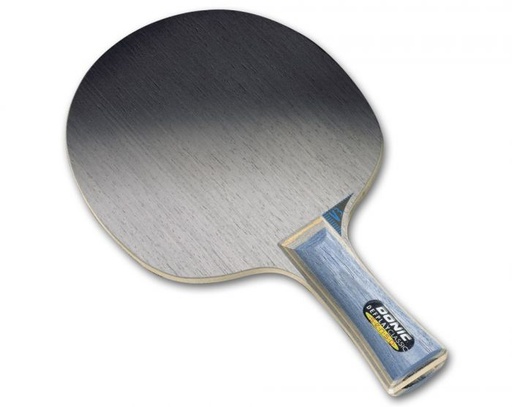
Open TT describes the typical blocker's bat as a firm blade that transmits little, with an attacking rubber on the other side. Choppers usually prefer a defensive blade such as the Donic Defplay Classic Senso or Spinlord Defender II.
FAQ
Are long pimples legal?
Yes, as long as the rubber is ITTF-authorised and within the thickness and pimple density limits above. Boosting or treating the rubber is not allowed.
Do long pips reverse spin every time?
No. How much spin comes back depends on the incoming spin, the stroke and whether you use sponge. That variation is the point.
Should a beginner use pimples?
Generally not. Table Tennis England recommends inverted rubber with a 1.5 mm sponge for beginners.
What does OX mean?
OX means the rubber has no sponge: just the pimpled topsheet glued straight onto the blade.
Sources: Table Tennis England: equipment guidance · ITTF Statutes 2026 (Laws of Table Tennis) · Open TT: Anti-spin, neither generating nor returning spin